Rising Damp Specialists · Ashgrove
Salt tide-marks, peeling paint and that musty smell along the skirting boards? We diagnose and permanently treat rising damp in Ashgrove's older Queenslanders and brick homes — with a proper diagnosis and a permanent fix, not a paint-over.
Tell us what you're seeing — or what your building report said — and we'll arrange a no-obligation on-site inspection and written quote.
We connect you with QBCC-licensed damp specialists servicing inner Brisbane. No obligation. The specialist's assessment fee is $450 plus GST. That includes up to two hours on site diagnosis, that may include camera inspection of the stormwater drains.
Why Ashgrove homes are prone to damp: Ashgrove is one of Brisbane's best-known character suburbs — leafy ridgelines and gullies lined with grand "Ashgrovian" interwar Queenslanders and early-1900s timber-and-tin homes, threaded by the Enoggera and Ithaca creeks. Two different damp stories sit side by side: the hillside homes, cut into sloping blocks with masonry piers and base walls that were never given a working damp-proof course; and the creek-flat homes, where the 2011 and 2022 floods saturated subfloors that can stay wet for years. Either way it surfaces as salt tide-marks, fretting brick and a musty smell low on the wall.
Know the signs
Rising damp only affects ground-floor walls, because the moisture comes from the soil. If you're seeing these signs low on the wall, it's worth a proper look before it damages the timber and brickwork.
SIGN 01
A horizontal stain about a metre up the wall, where the rising moisture peaks and evaporates.
SIGN 02
Efflorescence — ground salts crystallising on the brick or plaster surface.
SIGN 03
Finishes lifting and crumbling near the base of the wall.
SIGN 04
Soft, damp or warped skirting boards, architraves and floor timbers.
SIGN 05
A persistent damp, earthy odour, often strongest in closed rooms and low cupboards.
SIGN 06
In bad cases, the face of the brick crumbles away as the salts destroy the mortar.
Local knowledge
Ashgrove (4060) is defined by two things: its housing and its terrain. The suburb is the home of the "Ashgrovian" — a grander, more ornate interwar evolution of the Queenslander, with multiple gables, shingled bay windows and leadlight — alongside early-1900s timber-and-tin Queenslanders and post-war brick homes, most sitting on Ashgrove's rolling ridgelines and leafy gullies around Enoggera Hill.
On the hillside blocks, homes are cut into the slope and raised on brick piers and stumps. The timber stumps don't draw up ground moisture — but the masonry does: piers, base and dwarf walls and any built-in-under ground floor wick moisture upward, and most were built with no damp-proof course, or an early one that has since failed. Soil banked against the downhill wall adds lateral damp on top.
On the creek flats, it's a flood story. Ashgrove sits across the Enoggera and Ithaca Creek catchment, and the low-lying streets near the creeks flooded in both 2011 and 2022 — in 2011 creek water reached homes and driveways along the creek; in 2022, after two wet La Niña years, saturated ground and overland flow pushed water into pockets that had stayed dry in 2011. A flooded subfloor can hold moisture for years afterwards, feeding rising and subfloor damp long after the visible damage is repaired. Not sure which zone you're in? Check your address on Brisbane City Council's Flood Awareness Map.
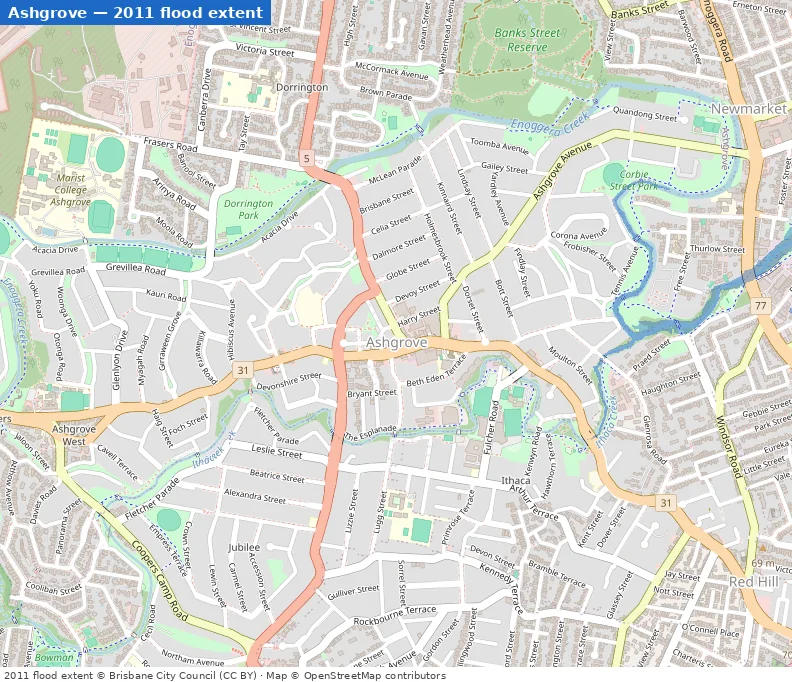
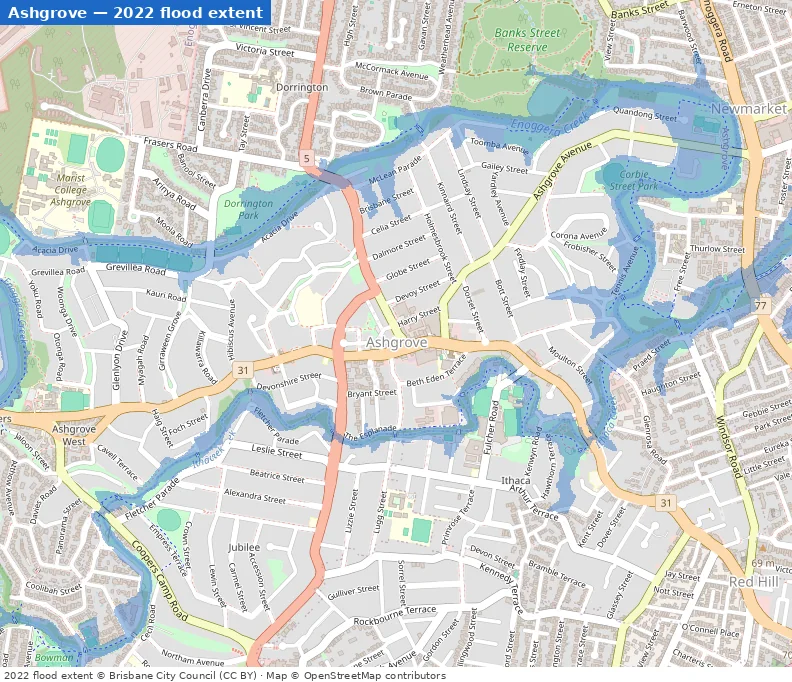
Because the causes differ, the fix does too. In an Ashgrove home "rising damp" is easily confused with subfloor moisture rising through an enclosed under-house space, or lateral damp from a cut-in block. We check all three during the assessment — the answer might be a chemical damp-proof course, subfloor ventilation, drainage, or a combination.
Nearby suburbs
How we fix it
Rising damp is often misdiagnosed as condensation or a leak, which need completely different fixes. We diagnose the actual cause first, then treat the source — not just the stain. It’s the same rising damp treatment in Brisbane we bring to every inner-suburb Queenslander.
We inspect with moisture meters, confirm it's genuinely rising damp, and rule out condensation or lateral damp.
We inject a new DPC into the mortar course — a water-repellent barrier that stops moisture rising, without removing bricks.
We strip salt-damaged plaster and apply a salt-retarding render so the damage doesn't return through the new surface.
We make good the wall and back the work with a 2-year warranty. If it's needed, we'll advise on subfloor ventilation too.
Our services
A new damp-proof course injected into the wall to permanently stop rising damp.
Learn more →Fans and vents to dry out the subfloor of Queenslanders on brick piers.
Learn more →Removing hygroscopic salts and re-rendering so the damage doesn't creep back.
Learn more →Fixing damp bridging from garden beds, paths and retaining walls.
Learn more →Transparent pricing
Rising damp treatment is usually priced by the linear metre of affected wall, so the size of the problem drives the cost. As a 2026 guide across Australia: a specialist damp assessment typically runs $500–$1,500 (ours is free), a chemical damp-proof course from a few thousand dollars up to around $15,000 on larger double-brick homes, subfloor ventilation about $1,500–$5,000, and re-rendering salt-damaged plaster roughly $3,000–$10,000 per wall.
Most single-room Ashgrove jobs land in the low-to-mid thousands
Your home may need only one of these or a combination — the only way to know for your home is a free call.
Indicative figures only — wall length, damp height and salt damage all change the price. We quote fixed, in writing, after the assessment.Common questions
Rising damp only affects ground-floor walls and peaks at a fairly even height — about a metre up — often with a salt tide-mark. Condensation usually shows higher and in corners or on cold surfaces; a leak is more localised. We confirm which one it is with moisture meters on site, because the three need completely different fixes.
That's one of the most common reasons Ashgrove owners call us. A building inspector flags the problem but doesn't fix it. We come out, confirm the extent, and give you a written quote you can use to negotiate on the purchase or plan the repair. Send us a photo of the report finding and we'll talk you through it.
If it's treated properly — a correctly installed chemical DPC plus salt-retarding render — it shouldn't. The 2-year warranty covers the workmanship. Paint-overs and quick fixes are what come back, because they don't stop the moisture at the source.
Yes — that's the bulk of the work in Ashgrove. Older Queenslanders often have no damp-proof course and poor subfloor airflow, so we frequently pair the DPC treatment with subfloor ventilation to keep the underfloor space dry.
Related, but not the same thing. A flood soaks the subfloor and lower walls, and near Enoggera and Ithaca Creeks that moisture can linger under the house for years, feeding rising and subfloor damp long after the visible repairs are done. We check whether you're dealing with residual flood moisture, true rising damp, or both — often the fix is subfloor ventilation plus a chemical DPC.
Yes — the grand Ashgrovian interwar Queenslanders and early-1900s timber homes are exactly the masonry-and-timber construction where rising damp turns up. Damp treatment is repair and maintenance and doesn't alter the protected external character, so it typically doesn't need a character-related approval; if your home is individually heritage-listed we'll flag anything that might.
Most residential jobs take one to a few days depending on wall length and how much plaster needs replacing. In most cases you can stay in the home; if a room needs to be closed off during treatment we'll let you know in advance.
Yes — the work is carried out by QBCC-licensed damp and waterproofing specialists, fully insured, to Australian standards.
Tell us what you're seeing — or what your building report said — and we'll arrange a no-obligation on-site inspection and written quote.
We connect you with QBCC-licensed damp specialists servicing Ashgrove. No obligation. The specialist's assessment fee is $450 plus GST. That includes up to two hours on site diagnosis, that may include camera inspection of the stormwater drains.
Nearby areas
 Rising Damp